Thursday, March 20, 2008

Zel: Somewhat Intense in Present Tense

Context: I found this book at the BYU bookstore’s book fair. My rule for myself as I stepped into the book fair was that I could not buy any book that cost more than $4. Zel was on sale for $3.50. Re-writings of fairy tales intrigue me and I’d never heard of the book, so I took a chance and spent the $3.50.

Summary: Zel is the re-telling of the classic fairytale Rapunzel. The story begins with a little girl and her mother making a special trip to town. You quickly find out that Zel doesn’t get to go to town very often. In fact, she doesn’t spend time away from her mother very often…or ever. She does really like animals and a special lettuce called rapunzel though. On this fateful trip to town she meets a boy. The boy plays the role of “prince” and proceeds to obsess over her for the remainder of the book. Eventually, you find out that Zel’s mother isn’t really her mother. Because the “mother” can’t stand to think that Zel could get married and leave her, she ends up locking Zel away in a tower using magical abilities for which she traded her soul to the devil. Zel spends months/years in the tower believing her “mother’s” story that she must stay in the tower because something terrible is out to get her. Eventually, she starts to go mad, which is really interesting since pieces of the tale are told from her point of view.

Analysis: The whole thing is very dramatic, especially since it’s entirely written in first person present tense. So, the story unfolds as if it’s actually happening. The disadvantage to this is that you really almost have to read it in one sitting. If you get out of the flow, it’s hard to get back in. She also switches narrators from character to character. Sometimes it’s the prince, sometimes it’s Zel, sometimes it’s the “mother.” Again, this makes it a little difficult to follow at times, but it also makes it very interesting because it’s almost like several re-tellings of the story in one. This re-telling really plays on mental and emotional energy. It’s almost depressing at points (i.e. when Zel goes psycho in the tower), but I wouldn’t label it as disturbing. However, I wouldn’t recommend it for anyone under the age of thirteen.

Educational Context: Several interesting concepts bounce around the novel. The idea of different points of view would be an interesting one to explore with a class. Also, the first person tense could be fun to experiment with in story telling. As far as media literacy discussions, I think it would be a good demonstration of the choices that are made when telling a story. Because it’s a book, this shows examples of how an author chose to tell a story in a novel, but you could also look at a song, a poem, a children’s book, a movie, a cartoon—other mediums in which stories are told and discuss the choices their creators made and how they effect the telling of the stories.

Wednesday, March 19, 2008

The Book Thief: Not Your Typical Holocaust Novel

Context: When I was doing a practicum at Mountain Ridge Junior High last fall, one of the teachers I worked with liked to recommend her latest good reads to her students. One of the books she recommended while I was in her classroom was The Book Thief by Marcus Zusak. A good friend of mine who shares my love for Young Adult fiction also recommended the book to me, so I decided to put it on my Christmas list. My grandma picked it out after discussing my book list with a bookstore clerk (who highly recommended that she buy the book for me), and so I ended up with my very own copy.

Summary: I’m not altogether sure how to summarize the book best. I think I’ll start by sharing what I saw when I opened to the first page of the rather unconventional novel. The first text in the book looks something like this:

“First the colors.

Then the humans.

That’s usually how I see things.

Or at least, how I try.

* * * HERE IS A SMALL FACT * * *

You are going to die

I am in all truthfulness attempting to be cheerful about this whole topic, though most people find themselves hindered in believing me, no matter my protestations…Just don’t ask me to be nice. Nice has nothing to do with me.

* * * REACTION TO THE * * *

AFOREMENTIONED FACT

Does this worry you?

I urge you—don’t be afraid

I’m nothing if not fair.”

I’ve cut some out where I put the ellipsis, but basically that’s it. Interesting effect, huh? The novel tells the story of a girl who finds herself collecting books in the middle of WWII Nazi Germany. You find that you can measure important parts of her life by the books she collects. She is a blonde, blue-eyed German so she’s safe from the fate of most holocaust novel heriones, but her adopted father doesn’t agree with all the Nazi practices. In fact, at one point in the novel they harbor a Jew in their basement. The book includes the theft of a book meant to be burned in one of the infamous Nazi book-burnings, the exploits of a neighborhood boy who idolizes Jesse Owens (not a popular guy with the Nazis…), and the bombing of the little girl’s town. In my opinion, the book doesn’t lend itself well to summary.

Analysis: The most intriguing part of this book for me is the narrator. It takes you a few chapters to figure it out (if you haven’t been informed) that the narrator is death. It’s a very interesting personification. Most authors use an omniscient narrator, a first-person narrator, or at least another character acts as the narrator, but because death is a character in every life, Zusak presumes that death will work well as a narrator. His presumption isn’t always correct. Parts of the book are confusing. Death gives away the end of the story way before the end comes. But in the end you get the feeling that Zusak wanted it to be a little confusing. Holocaust Germany was confusing. So, while the narrator may not work the best as far as telling the story goes, it definitely works the best as far as telling the message of the story, giving the Holocaust atmosphere, and capturing the reader go. He’s taken a fairly set genre—the novel in prose—and blown it to pieces. He breaks almost every rule there is to telling a story, using proper punctuation and grammar, writing in paragraph format, etc. but all that breaking of convention really aides in the story-telling somehow. I can count on one hand the times a book has made me cry. This book made me cry at the end even though I already knew what was going to happen and how it was going to end. The narrator gave away the ending a fourth of the way through the book, and I still cried when I read that ending. Now that is good story-telling!

Educational Context: This is a great text for showing the unconventional things you can do to create effects in writing. Bold letters, asterisks, headings, points of view, order of events, etc. are all elements of the writing in this novel. Marcus Zusak really breaks the norm. I think this is also a good example of how genres are changing. A novel doesn’t have to be page after page of solid paragraphs any more. This could start a good discussion about how media develops.

Arby’s $5 Buck Roundup: Hot Deals or Money Steals

Context: Every week, we get piles and piles of advertisements in our tiny college mailboxes. Do we ever really look at them? No. When I went to check the mail a few days ago, one of the annoying ads fell out of the pile and started to blow away. Lest I be labeled a litterer, I chased after the offending paper, though I wasn’t thrilled to be doing so.

Summary: When I picked it up, I noticed it was another one of those Arby’s ads with coupons boasting 2 Fish Sandwiches for $5, 3 Beef ‘n Cheddar Sandwiches for $5, or 4 Regular Roast Beef Sandwiches for $5. The title of the obnoxious ad: “Arby’s $5 Buck Roundup.” If you turn over the ad, the back has several coupons with the five-dollar deals printed on them.

Analysis: Honestly, there’s not a whole lot you can buy with $5 anymore. Five dollars will barely even get you a McDonalds value meal. So this is a pretty good deal right? I mean, say you’re a married couple in college, tired of cooking your meals—Arby’s is a great place to go and get three beef ‘n cheddar sandwiches for five dollars. Voila! There’s dinner for two. But wait a second…what about the fact that once you get there, you’re going to realize just how little food three beef ‘n cheddar sandwiches constitutes. Besides, once you’re there, you’ll want some Arby’s curly fries…and some drinks…and that new chocolate turnover thing looks pretty good…and BAM! All the sudden you’ve spent ten dollars on top of the five dollars you spent on your beef ‘n cheddar sandwiches. Precisely what Arby’s wants you to do. You poor college students—roped into the “$5 buck roundup!” And, to add to the irony, you didn’t even have to bring in your carefully cut coupon. Arby’s deals are open to anyone, regardless of whether or not they are in possession of a coupon, the ad just includes coupons to make you feel special.

Educational Context: This is a perfect example of deceptive, yet effective advertising. Arby’s may eat some money on the production costs of the three beef ‘n cheddars you can get for $5 (although that’s doubtful), but in the end, they get plenty of money out of their customers because they know that 3 beef ‘n cheddars just won’t cut it once you enter the actual establishment. Helping students understand the language of advertising is helping them understand a part of the media world they will constantly deal with. If that theoretical college couple had asked themselves questions about the ad and really thought it through, or if their teachers had taught them about advertising schemes, perhaps they would have stayed home and made their own beef ‘n cheddar sandwiches for a much better price.

Haiku to a Cow: An Indian Missionary’s Poem to Home

Context: When we talked about haikus in class a few weeks ago, I immediately thought of this missionary haiku. My brother had been in India for about five months when my cousin wrote to him requesting a tidbit for the family newsletter. Lincoln, a naturally clever and witty young fellow wrote back with his “Haiku to a Cow”

The Poem:

Haiku to a Cow

Sagging skin, so slim

Eating trash by the roadside

I do not miss beef

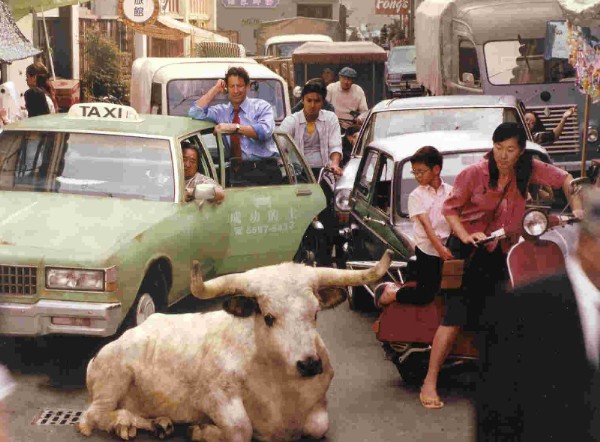
Analysis: Lincoln really was a very clever missionary. He took a concept associated with India—the custom to revere the cow as sacred—and completely humanized it. This cow is not white, flower-covered, or sacred. This is a scrawny, wiry cow he saw eating trash by the road one day, which made him glad that Indians don’t eat much beef. Really, I think this haiku says a lot about my brother’s experience as a missionary in India. The misconceptions and glorifications of all kinds of aspects of his life including religion, humanity, and Indian culture were proven to be unrealistic. The realities were just skinny old cows eating trash on the road.

Educational Context: Using this and some haikus we talked about in class as models, I could have my students pick a misconception in their worlds and write a haiku about their true feelings after some inquiry into the truth behind the belief. I think this could be a good exercise in inquiry (I would encourage them to use several sources including books, internet, interviews, opinions, news articles, etc.) as well as an exercise in looking beyond commonly held beliefs. Perhaps I could even have them pick a misconception presented by the media, then we could have a conversation about the untrue views the media often presents.

The Eyre Affair: Nothing’s More Fun than Re-writing Endings!

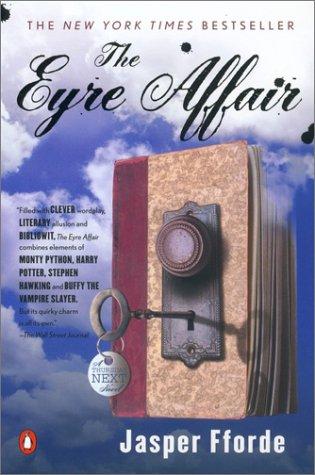
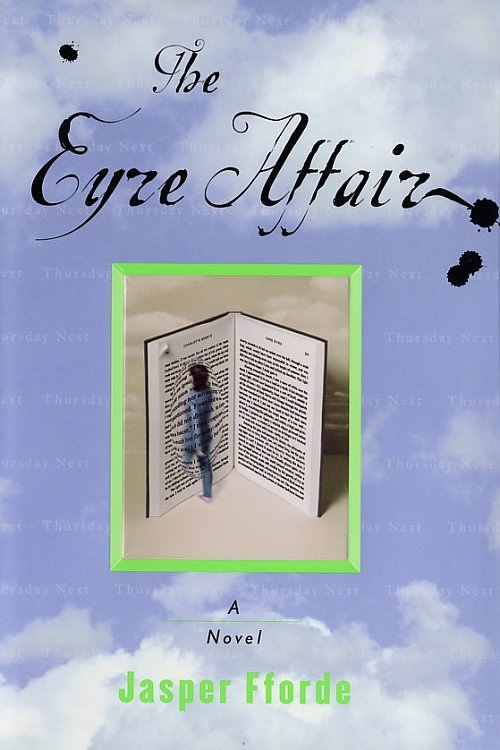
Context: When my little sister informed me that my brother Lincoln had drawn my name for Christmas, I have to admit I was a little worried. After all, Lincoln and I are not the most compatible siblings you’ve ever met (probably because we’re only about a year and a half apart, so we had classes together in church and school all growing up—there was bound to be some sort of rivalry). I wasn’t surprised to see the book-shaped package under the Christmas tree when I got home, the question was, what book(s)? Answer: two Jasper Fforde novels (sequels). I hadn’t ever heard of the novels, but I was intrigued by the title of the first—The Eyre Affair—not to mention the quotes on the back cover.

"Jasper Fforde's fascinating first novel reads like a Jules Verne story told by Lewis Carroll." - Susanna Yager, Daily Telegraph

"What Fforde is pulling, of course, is a variation on a classic Monty Python gambit: the incongruous juxtaposition of low comedy and high erudition. Though not wholly original -- these days, what is ? -- this scam hasn't been pulled off with such off-hand finesse and manic verve since the Pythons shut up shop. The Eyre Affair is a silly book for smart people: postmodernism played as raw, howling farce." - Charles Shaar Murray, The Independent

Naturally I was surprisingly pleased with Lincoln’s choice and more than a little bit intrigued. With back-cover quotes like those, can you blame me?

Summary: The book is remarkably hard to explain without going into a pretty extensive summary, so I’m just going to include Penguin Publisher’s marketing blurb about the novel which is about as good as you can get for a short summary:

“In Jasper Fforde's Great Britain, circa 1985, time travel is routine, cloning is a reality (dodos are the resurrected pet of choice), and literature is taken very, very seriously. England is a virtual police state where an aunt can get lost (literally) in a Wordsworth poem and forging Byronic verse is a punishable offense. All this is business as usual for Thursday Next, renowned Special Operative in literary detection. But when someone begins kidnapping characters from works of literature and plucks Jane Eyre from the pages of Brontë's novel, Thursday is faced with the challenge of her career. Fforde's ingenious fantasy—enhanced by a Web site that re-creates the world of the novel—unites intrigue with English literature in a delightfully witty mix.”

Analysis: I absolutely loved Jasper Fforde’s carefree parody and commentary on British socio-political policy. A particular favorite premise of mine was the ridiculous Crimean War. Having just written a term paper on Tennyson’s “The Charge of the Light Brigade,” I had polished up on my Crimean War history enough to appreciate the sheer ridiculousness of Fforde’s scenario. There’s nothing like re-writing history to provide some fun social commentary. Also, as a pretty big fan of Charlotte Bronte’s Jane Eyre, I was tickled with the whole concept of jumping into a novel, kidnapping characters, and changing endings. Another bright moment was the slightly-crazy aunt getting caught in the Wordsworth Poem “I Wandered Lonely as a Cloud” and getting hit on by the poet in a field of his own imagined daffodils. I also thought it was great that the British people in the novel are so obsessed with their own literature that they consider it a federal crime to try to pass off one of your own poems as Byron or Keats or to stage a bad performance of a Shakespeare play. The novel was slow at times, and I wouldn’t have understood half the references and allusions if I hadn’t just finished a British Literature class before reading it, but it made me feel really smart because I did catch most of the humor, and it was extremely clever.

Educational Context: This would be an excellent novel for teaching historical parody. I could ask my students to pick an historical event to parody themselves using Jasper Fforde as a model. I probably wouldn’t use it with anyone below the eleventh or twelfth grade level, but it would be fun in a European History or British History class. The concept of books within books could be pretty interesting to delve into with advanced students as well. Fforde uses some pretty intense sentence structure with lots of appositives and participial phrases—some good sentence examples for teaching grammar could come out of this book for sure. This could also be a good premise for a discussion about the popularity of print media. I think most of my students would agree that our world today is digital, and the book, magazine, and newspaper mediums are kind of out of style. However, in the world Fforde has created, nothing is more important that books, manuscripts, papers, etc. So much so that it’s a federal crime to burn a book. Print media in this novel and print media in today’s society fulfill very different roles.

Mr. Wyview: A Brilliant Publicity Scheme

Context: Part of my job with the BYU Residence Halls Association (RHA) is to train the three area councils (one student council-type organization for each of the three areas: Helaman Halls, Heritage Halls, and Wyview Park). In January, we took the councils up to Spring Haven (a BYU-owned facility in Hobble Creek Canyon) for a winter training retreat, and I got to teach them about effectively publicizing their programs. During the Fall semester, the councils had put up some pretty pathetic publicity (some flyers didn’t even include times and locations), so it was my assignment to give the training necessary to avoid pathetic publicity this winter semester. I must have done a pretty good job because Wyview Park put on a mock-pageant entitled Mr. Wyview: Is it in You? And they did a pretty darn good job if I do say so myself.

Summary: The first round of publicity came out two weeks before the program. It included a date, time, and place, and included a parody of the well-known Gatorade slogan: “Is it In You?” They used an orange lightening bolt similar (but not the exact same—wouldn’t want to break copyright laws) as a kind of logo for the flyer. On the flyers they tacked in front of each girls’ apartment in Wyview, they included a line about encouraging their guy friends to fill out a pageant application. On the boys apartments, they tacked a paper application along with the flyer. Their next round of publicity came out a week before the Mr. Wyview Pageant. For this publicity blitz they used donated Burger King Crowns with quarter-sized flyers showing the date, time, and slogan of the program. They stapled the crowns to the stair-railings of every stairwell in Wyview. The third publicity round was the t-shirts they designed. The t-shirts showed the orange lightening bolt on the front with the words “Mr. Wyview: Is it in You?,” and on the back the name, date, time, and location of the event. They gave the t-shirts to every RA in Wyview, each Wyview council member, and then each council member gave away three t-shirts to students living in Wyview. Everyone who was given a shirt was asked to wear it twice during the week leading up to the event so people would see the shirts and the program would be publicized. The event was jam-packed full of people. In fact, there weren’t nearly enough seats, and for the first time in RHA history, they ran out of refreshments.

Analysis: The Wyview council did several notable things with this publicity scheme. First, they chose a well-known slogan and logo. Normally, when people see those words they think, Gatorade. In my mind, I also see the Gatorade commercials with athletes sweating Gatorade. So, when paired with a mens’ mock beauty pageant, the slogan implies a competition (perhaps athletic) for the status of Mr. Wyview. Slogans and logos taken out of context are also eye-catching and curiosity-piquing. Second, they used Burger King Crowns, which have happy food connotations for many, to publicize an event in which the winner would be crowned. When somebody sees a Burger King Crown stapled to their stairwell, they stop and look…after all, it could be Burger King coupons or something associated with free food—always a good angle to take with college students. Third, the t-shirt publicity. Let’s face it: everybody loves a free t-shirt, and what better publicity is there than t-shirt-wearing, living, walking, talking people? Besides, the giving of free t-shirts before an event implies that perhaps more free things will be given at the event itself—again, always a good angle to take with college students.

Educational Context: If, for some strange reason, I were to discuss this publicity scheme with my students some day (…I guess it’s plausible that I could be teaching a publicity workshop again at some point, so I suppose I could use this as an example), we could talk about the different mediums this council used to publicize. They took objects (Burger King Crowns) and took them out of their contexts to grab the attention of passers-by. They used well-known objects and slogans to publicize a little known event—but they also took a chance that some people might not recognize the significance of those objects and slogans. Why was this worth the risk? Could they have picked a more universal slogan? What does this say about how media-savvy the residents of Wyview Park are (we’re assuming, based on the high attendance, that most of them recognized the slogan)? Perhaps I would even create a make believe event for which my students would be assigned to design a publicity scheme. I could probably even modify this for my students to publicize an event from a novel or short story. Hmm…I bet they could come up with some pretty interesting ideas for publicizing “the lottery” from Shirley Jackson’s short story…

Onward Alone: A Dance Concert with Emphasis on the…Speaking Parts?


Context: Last year, I decided to go to the Dance in Concert. It was a last-minute decision and I have to admit the main reason I went was the free tickets I got from a friend. I expected it to be somewhat neat, but I was knocked off my feet. I absolutely loved it! So, this year, I waited anxiously for the poster-ads to go up. When I saw the kind of corny-looking posed poster with the girl in the pioneer dress, I wasn’t daunted. I assured my roommates the whole pioneer thing was probably only for one number and they’d have other cool dance numbers too. My roommates were doubtful but they bought tickets after hearing my glowing, enthusiastic assurance. Unfortunately, we were all a little disappointed.

Summary: Unlike the traditional Dancers' Company Concert, this year’s program was all based on the same story. Instead of several different numbers with different types of choreography, cool lighting changes, interesting use of props, and various styles of music, the company performed a series of pieces telling stories of Mormon pioneer women and their husbands who left them to join the Mormon Battalion. Some pieces used music, some used visual images projected onto the stage, and some used only narration.

Analysis: I thought the mixing of mediums was a neat idea, but perhaps the pioneer theme was not the greatest for this mixture. It came off as a little sappy at several points during the program. I got particularly squirmy when a video of some of the dancers dancing around on a hill came up at the same time as a spoken narration and dancers on the stage. The bizarre juxtaposition of these didn’t fit the seriousness of the story, and it made me want to laugh. I think it was mainly the film. The lighting was bad, the film quality wasn’t great, and it did a real injustice to the dancers and their subject matter. In all fairness, I was expecting something completely different from this program, so part of my disappointment is due to the fact that the program was organized differently when compared to last year’s concert.

Educational Context: If I could have taken a classroom of students to this concert, it would have set up perfectly for a discussion about how different subject matters match up with different mediums of media/technology. I would prompt my students to think about the differences between dancing to music, dancing in silence, and dancing to speaking parts and how those differences communicated the atmosphere and aura the dancers were trying to create.