Thursday, March 20, 2008

Midsummer Night’s Dream: Pretty, Creepy, Funny…What a Combination!
Description: I’m not going to go into a detailed summary of the plot of Midsummer Night’s Dream. I’m hoping/assuming that most are familiar with the basics of the story. I’m thinking I’ll just mention the two things that stuck out to me about this particular production of the play: first, the playbill introduced the director’s concept of using the play as a demonstration of the flow of colonization, and second, the Brazilian martial arts that inspired the movements of the fairy world.

Analysis: If not for the playbill, I wouldn’t have necessarily understood the message the director was trying to convey about colonization. Perhaps this is a reflection of lack of theater experience on my part, but I consider myself more literate in the theater world than your average person, so I don’t think we can entirely blame lack of theater training. Besides, this blog is about my views anyway. I understood the contrast between the fairy world and the Athenian world, but I didn’t connect that with colonization at all until I read the playbill during intermission. I think it was a worthy effort, but the colonization commentary was a bit of a stretch—the methods they used to communicate it just blended with the story for me so much that they didn’t even really stand out enough to communicate the message effectively. The Brazilian dancing and sounds were fun and pretty. They added a pretty cool effect to the fairy world. I actually liked the creepy, eerie feeling—it was a good reflection of the danger of the fairy world in my opinion. The only thing that really got to me is that everything was pretty, the delivery was funny, but the acting wasn’t fabulous. I was never really pulled into the Shakespeare world. I never forgot it was a play. I can’t really pin down what made the acting mediocre in particular, I just felt like it didn’t pull me in like it could have.
Educational Context: I think this production was a great example of using movements to communicate themes and messages. The visualization of a make-believe world like the world of the fairies is a huge challenge, and I think it was done well here with the Brazilian Capoeira-inspired movements. Perhaps I could take another novel, play, etc. that juxtaposes two worlds and have my students demonstrate how they would show the difference between the two worlds using movement.
Zel: Somewhat Intense in Present Tense
 Context: I found this book at the BYU bookstore’s book fair. My rule for myself as I stepped into the book fair was that I could not buy any book that cost more than $4. Zel was on sale for $3.50. Re-writings of fairy tales intrigue me and I’d never heard of the book, so I took a chance and spent the $3.50.
 Summary: Zel is the re-telling of the classic fairytale Rapunzel. The story begins with a little girl and her mother making a special trip to town. You quickly find out that Zel doesn’t get to go to town very often. In fact, she doesn’t spend time away from her mother very often…or ever. She does really like animals and a special lettuce called rapunzel though. On this fateful trip to town she meets a boy. The boy plays the role of “prince” and proceeds to obsess over her for the remainder of the book. Eventually, you find out that Zel’s mother isn’t really her mother. Because the “mother” can’t stand to think that Zel could get married and leave her, she ends up locking Zel away in a tower using magical abilities for which she traded her soul to the devil. Zel spends months/years in the tower believing her “mother’s” story that she must stay in the tower because something terrible is out to get her. Eventually, she starts to go mad, which is really interesting since pieces of the tale are told from her point of view.
Analysis: The whole thing is very dramatic, especially since it’s entirely written in first person present tense. So, the story unfolds as if it’s actually happening. The disadvantage to this is that you really almost have to read it in one sitting. If you get out of the flow, it’s hard to get back in. She also switches narrators from character to character. Sometimes it’s the prince, sometimes it’s Zel, sometimes it’s the “mother.” Again, this makes it a little difficult to follow at times, but it also makes it very interesting because it’s almost like several re-tellings of the story in one. This re-telling really plays on mental and emotional energy. It’s almost depressing at points (i.e. when Zel goes psycho in the tower), but I wouldn’t label it as disturbing. However, I wouldn’t recommend it f
Educational Context: Several interesting concepts bounce around the novel. The idea of different points of view would be an interesting one to explore with a class. Also, the first person tense could be fun to experiment with in story telling. As far as media literacy discussions, I think it would be a good demonstration of the choices that are made when telling a story. Because it’s a book, this shows examples of how an author chose to tell a story in a novel, but you could also look at a song, a poem, a children’s book, a movie, a cartoon—other mediums in which stories are told and discuss the choices their creators made and how they effect the telling of the stories.
Wednesday, March 19, 2008
The Book Thief: Not Your Typical Holocaust Novel
 Context: When I was doing a practicum at Mountain Ridge Junior High last fall, one of the teachers I worked with liked to recommend her latest good reads to her students. One of the books she recommended while I was in her classroom was The Book Thief by Marcus Zusak. A good friend of mine who shares my love for Young Adult fiction also recommended the book to me, so I decided to put it on my Christmas list. My grandma picked it out after discussing my book list with a bookstore clerk (who highly recommended that she buy the book for me), and so I ended up with my very own copy.
 Summary: I’m not altogether sure how to summarize the book best. I think I’ll start by sharing what I saw when I opened to the first page of the rather unconventional novel. The first text in the book looks something like this:
“First the colors.
Then the humans.
That’s usually how I see things.
Or at least, how I try.
* * * HERE IS A SMALL FACT * * *
You are going to die
I am in all truthfulness attempting to be cheerful about this whole topic, though most people find themselves hindered in believing me, no matter my protestations…Just don’t ask me to be nice. Nice has nothing to do with me.
* * * REACTION TO THE * * *
AFOREMENTIONED FACT
Does this worry you?
I urge you—don’t be afraid
I’m nothing if not fair.”
I’ve cut some out where I put the ellipsis, but basically that’s it. Interesting effect, huh? The novel tells the story of a girl who finds herself collecting books in the middle of W
Analysis: The most intriguing part of this book for me is the narrator. It takes you a few chapters to figure it out (if you haven’t been informed) that the narrator is death. It’s a very interesting personification. Most authors use an omniscient narrator, a first-person narrator, or at least another character acts as the narrator, but because death is a character in every life, Zusak presumes that death will work well as a narrator. His presumption isn’t always correct. Parts of the book are confusing. Death gives away the end of the story way before the end comes. But in the end you get the feeling that Zusak wanted it to be a little confusing. Holocaust
Arby’s $5 Buck Roundup: Hot Deals or Money Steals
Context: Every week, we get piles and piles of advertisements in our tiny college mailboxes. Do we ever really look at them? No. When I went to check the mail a few days ago, one of the annoying ads fell out of the pile and started to blow away. Lest I be labeled a litterer, I chased after the offending paper, though I wasn’t thrilled to be doing so.
Summary: When I picked it up, I noticed it was another one of those Arby’s ads with coupons boasting 2 Fish Sandwiches for $5, 3 Beef ‘n Cheddar Sandwiches for $5, or 4 Regular Roast Beef Sandwiches for $5. The title of the obnoxious ad: “Arby’s $5 Buck Roundup.” If you turn over the ad, the back has several coupons with the five-dollar deals printed on them.
Analysis: Honestly, there’s not a whole lot you can buy with $5 anymore. Five dollars will barely even get you a McDonalds value meal. So this is a pretty good deal right? I mean, say you’re a married couple in college, tired of cooking your meals—Arby’s is a great place to go

Haiku to a Cow: An Indian Missionary’s Poem to Home
 Context: When we talked about haikus in class a few weeks ago, I immediately thought of this missionary haiku. My brother had been in
 The Poem:
Haiku to a Cow
Sagging skin, so slim
Eating trash by the roadside
I do not miss beef
Analysis:
Educational Context: Using this and some haikus we talked about in class as models, I could have my students pick a misconception in their worlds and write a haiku about their true feelings after some inquiry into the truth behind the belief. I think this could be a good exercise in inquiry (I would encourage them to use several sources including books, internet, interviews, opinions, news articles, etc.) as well as an exercise in looking beyond commonly held beliefs. Perhaps I could even have them pick a misconception presented by the media, then we could have a conversation about the untrue views the media often presents.
The Eyre Affair: Nothing’s More Fun than Re-writing Endings!
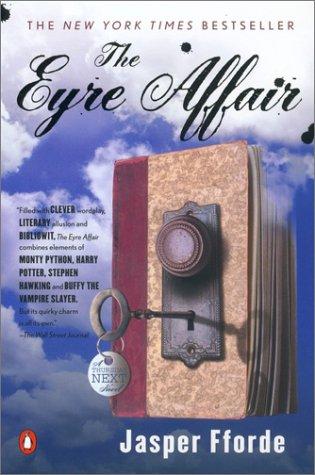 Context: When my little sister informed me that my brother Lincoln had drawn my name for Christmas, I have to admit I was a little worried. After all, Lincoln and I are not the most compatible siblings you’ve ever met (probably because we’re only about a year and a half apart, so we had classes together in church and school all growing up—there was bound to be some sort of rivalry). I wasn’t surprised to see the book-shaped package under the Christmas tree when I got home, the question was, what book(s)? Answer: two Jasper Fforde novels (sequels). I hadn’t ever heard of the novels, but I was intrigued by the title of the first—The Eyre Affair—not to mention the quotes on the back cover.
 "Jasper Fforde's fascinating first novel reads like a Jules Verne story told by Lewis Carroll." - Susanna Yager, Daily Telegraph
"What Fforde is pulling, of course, is a variation on a classic Monty Python gambit: the incongruous juxtaposition of low comedy and high erudition. Though not wholly original -- these days, what is ? -- this scam hasn't been pulled off with such off-hand finesse and manic verve since the Pythons shut up shop. The Eyre Affair is a silly book for smart people: postmodernism played as raw, howling farce." - Charles Shaar Murray, The Independent
Naturally I was surprisingly pleased with
Summary: The book is remarkably hard to explain without going into a pretty extensive summary, so I’m just going to include Penguin Publisher’s marketing blurb about the novel which is about as good as you can get for a short summary:
“In Jasper Fforde's Great Britain, circa 1985, time travel is routine, cloning is a reality (dodos are the resurrected pet of choice), and literature is taken very, very seriously.
Educa